


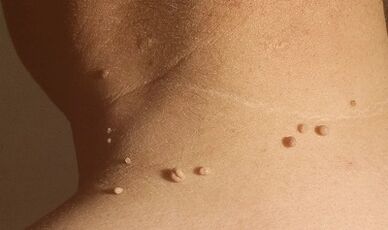
Papillomas are benign skin tumors that appear in the form of small growths and warts.Today, papillomas have been shown to be of viral origin.You can contract the disease through household contact when the virus enters the skin through minor injuries and microtears.Currently, several main types of papillomas have been discovered: flat, simple, plantar, filiform, and apical.Some papillomas are spread through unprotected sex.Such tumors are known as genital warts and pose a huge risk to women's health.Their location is the external genitalia, the cervix.Such papillomas usually go unnoticed because they do not reveal their presence in any way.However, it is highly likely to transform into malignant tumors of the cervical mucosa.
causes of papilloma
The cause of the disease is human papillomavirus (HPV), which belongs to the Papilloviridae family.Once inside the body, papillomaviruses invade the basal cells of the epithelium, where they actively multiply.The appearance of papillomas or warts on the skin is the result of high viral activity.The tumor itself is composed of epithelial tissue that contains blood vessels, so damage can lead to bleeding.
Most papillomas on the outer skin of the body develop without any symptoms.Sometimes, they feel themselves through mild tingling and itching on the skin.Papillomas can be identified by their appearance.Externally, it appears as a small growth that protrudes above the skin and is usually no different in color from the skin.Light brown papillomas are sometimes found.Large tumors up to two centimeters located in open areas of the body (neck, shoulders, face) may cause cosmetic discomfort.
Papillomas are usually caused by a weakened immune system that is unable to respond promptly to viruses that enter the body.Risk factors include: smoking, alcohol abuse, constant stress, digestive disorders, and promiscuity.You can also contract the disease while visiting swimming pools, saunas and public baths.Papillomas are passed from mother to baby at birth.The virus lies deep in the epithelium, where it cannot be sensed and is therefore thought to be dormant.It poses no threat to its carrier or its environment.Therefore, its presence in humans is not an indication for treatment.Papillomas become contagious when they reach the upper layers of the skin and sit above the skin's surface in the form of visible tumors.
Papilloma Treatment
Self-treatment of papillomas is not recommended.At best, there is no positive outcome; at worst, secondary infection develops under the skin.You cannot cut out, pull out, or comb or scrape papillomas with your fingernails.Over time, an improperly removed papilloma can form again in the same location.Therefore, this delicate question should be entrusted to a specialist - a dermatologist.

There are several methods of papilloma removal today:
- electrocoagulation;
- laser removal;
- Remove with radio knife;
- Freezing damage.
Electrocoagulation involves exposing the affected area of skin to high-frequency electric current, under the influence of which protein tissue coagulates.Anesthesia is used when large papillomas are removed.The main advantage of this method is that the removal process itself is completely bloodless and leaves no visible traces of medical intervention on the skin afterwards.
Using lasers for medical purposes makes life easier for both doctors and patients.Today, surgeries using lasers are much more serious than removing ordinary warts.Laser removal of benign skin tumors is recognized worldwide.It has many advantages: the procedure is quick, relatively painless, and blood and scarring do not form on the skin after the papilloma is removed with a surgeon's scalpel.After laser papilloma removal, a thin protective film will form on the patient's skin, which will disappear on its own after 12-14 days, leaving healthy skin that is no different from other parts of the body.
For patients who are concerned about the recurrence of papillomas or who have already experienced unsuccessful papilloma removal, it is recommended to remove the tumor using a special radiotome, which removes the entire area of epithelial tissue and the papilloma located above it.Of course, the surgery is performed under anesthesia and guarantees lifelong relief from papillomas in that area of skin.
Another modern method of removing unwanted imperfections in the skin is cryodestruction - cauterizing tumors using liquid nitrogen.The procedure itself is painless, but there is a drawback - in some cases, such as genital warts, it is ineffective.
Experts can recommend which method is most effective for papilloma removal in each specific situation.Having decided to eliminate once and for all the unpleasant manifestations of viruses from the skin, you should pay special attention to the institution in which the operation is performed.Many beauty salons now offer removal of moles, papillomas and warts at relatively low fees, but most salons cannot guarantee complete safety and the absence of adverse consequences.Practice shows that it is recommended to remove all skin tumors, including papillomas, only in a medical institution and after consultation with a dermatologist, who will diagnose the disease, determine its exact origin and then prescribe an excision procedure.